Disorder free demo and game overview
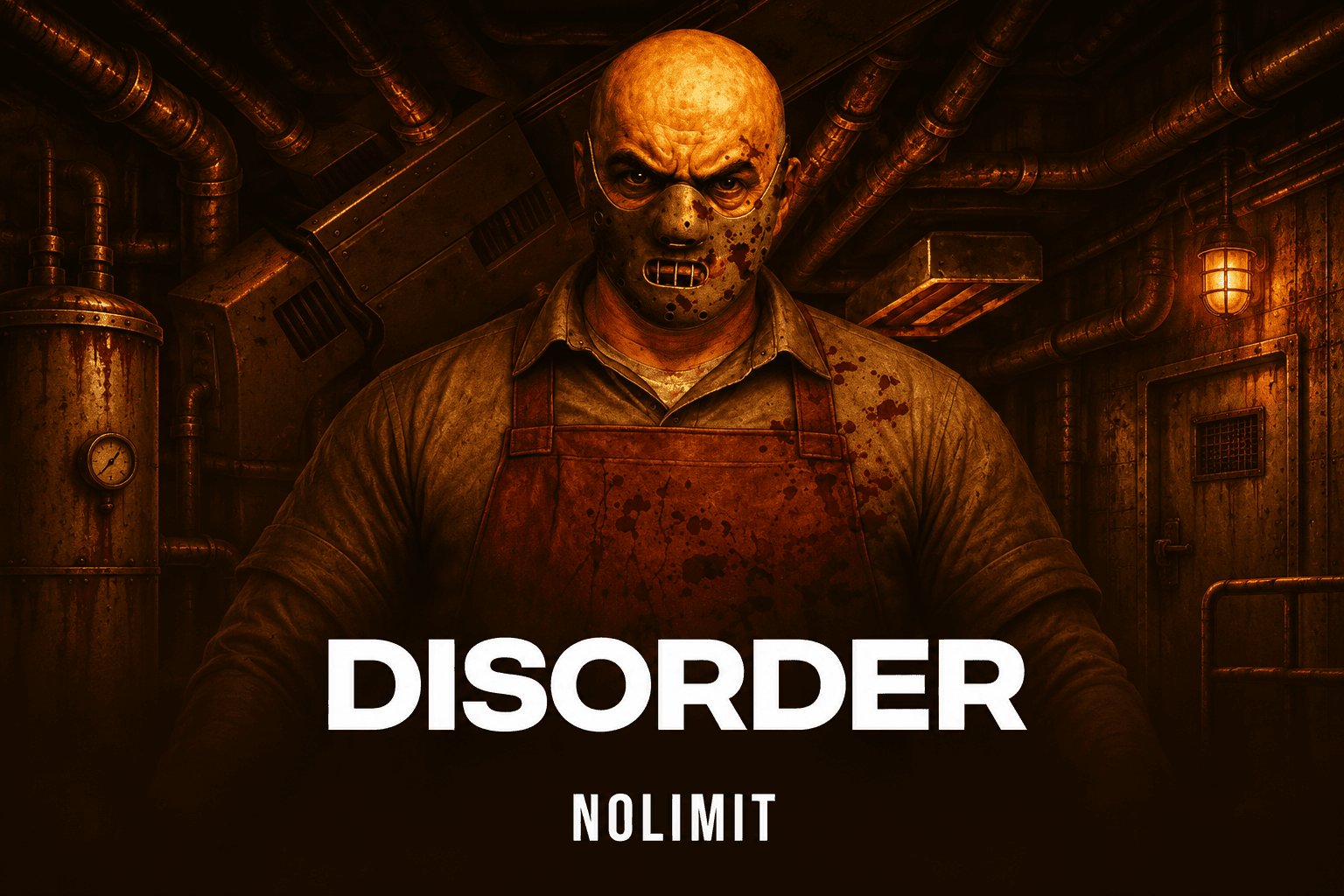
Disorder is a psychological-horror video slot from Nolimit City, released on 4 November 2025. It follows John Smith, a seemingly ordinary family man whose carefully ordered home becomes the setting for an increasingly disturbing story. The game is presented as an origin story connected to the developer's Mental series, but it also works as a standalone slot. Its central systems are Fire Frames, Enhancer Cells, Infectious xWays, xBomb Wilds and three levels of free spins. The free demo provides a practical way to explore the rules and understand what each visual change means without depositing money.
The game has six reels arranged in a 4–3–4–3–4–3 pattern. This means the first, third and fifth reels have four visible positions, while the other three have three. Its starting arrangement provides 1,728 possible winning ways before any symbol-splitting effects. The published standard return to player is 96.11%, the hit frequency is 25.95%, and the advertised maximum award is 23,500 times the base bet. The developer also reports an approximate free-spin frequency of one in 270 and maximum-win probability of one in 2.7 million. These are mathematical descriptors of the model, not expectations for any individual demo session.
The distinguishing idea is that a spin does not always finish when the first combination is evaluated. Cascades allow a result to develop, Fire Frames can split symbols, and Enhancer Cells can alter the board or increase multipliers. The three free-spin tiers then change how these enhancements persist. Understanding the order of events makes the game much easier to follow than simply watching a large number appear on the screen.
How to play Disorder for free
Starting the demo
Launch the demo player and allow the game to load. The usual controls show a virtual balance, a selected stake and a spin button. You can adjust the available demo stake and observe the results using non-cash credits. There is no need to make a deposit to read the paytable or inspect the mechanics in a working free version. If an embed does not load, this may be caused by the demo host, browser settings or regional availability; it does not change the rules described here.
Use the information or help menu inside the game to inspect the symbol awards before spinning. First notice the six-reel shape, the special spaces at the foot of reels two, four and six, and the signs identifying Fire Frames. Then play several regular demo rounds to recognize when ordinary matches, symbol splits and extra modifiers occur. Understanding these recurring sequences is more valuable than immediately searching for the highest bonus tier.
Virtual credits and the displayed stake
The published stake interval is €0.20 to €100.00, although a demo may display a different currency or a virtual-credit denomination. A selected amount defines the base used for calculating awards. For example, a win of 10× means ten times the base bet, regardless of whether the demo counter is labelled in euros or test credits. This is a mathematical illustration, not an indication of likely returns.
Some versions include optional boosters or direct bonus access. These are game interfaces that alter the cost and feature distribution when offered. They are not needed to experience normal spins. Demo credits are not withdrawable and provide no basis for predicting real-money outcomes.
Reels, winning ways and cascades
Understanding the 4–3–4–3–4–3 grid
Disorder's uneven reel heights are important because they form the underlying 1,728-way arrangement. The game uses ways to win instead of asking the player to choose a set of fixed paylines. The reel evaluation determines whether matching payable symbols form an eligible combination. Do not confuse a group of similar pictures anywhere on the screen with an automatic win; the direction and rules of matching matter. The paytable in the game remains the authoritative reference for individual symbol awards.
When special effects split a regular symbol, one position can contribute additional instances and the number of potential ways can increase. A large displayed ways count is therefore not necessarily a guarantee of a large payout. It means more eligible connections may be available, subject to the actual symbol combination and the game's evaluation.
Why the same round can have several stages
After a qualifying result, winning symbols can be removed and fresh symbols can fall into the available spaces. This is the cascade process. The updated grid is then checked again, sometimes producing another win and another collapse. Fire Frames and Enhancer Cells may affect the board during these stages, so pay attention to whether an effect belongs to the current round or a new spin.
In the demo, a useful exercise is to track one spin from its first stop to the final total. Note which symbols participated in the first win, what was removed, whether a multiplier changed, and what appeared next. Disorder can become visually busy, and following that order prevents a common mistake: assuming all flashes or explosions represent independent paid spins.
Fire Frames explained
Splitting normal symbols
Fire Frames appear at random positions on the reels. When a symbol occupies a Fire Frame, it can be split into two parts. A regular paying symbol can be split repeatedly but has a published maximum of 16 parts. The effect changes how many instances of that symbol can contribute to possible winning connections. It does not automatically turn every split into an award; the final combination still has to qualify.
Fire Frames are also the trigger for the Enhancer Cells underneath selected reels. This gives the frames two jobs: they can modify the symbols on the board and they can unlock additional feature actions. Reading both effects together explains why a round with several frames may behave very differently from a round without them.
Upgrading Bonus to Super Bonus
When a Bonus symbol lands in a Fire Frame, it upgrades to a Super Bonus symbol. That change is particularly important during bonus triggering. The game distinguishes normal Bonus symbols from Super Bonus symbols when deciding which free-spin tier is awarded. A frame hitting a Bonus symbol is therefore more than an ordinary split effect: it may change the level of the bonus feature being entered.
Do not treat a Super Bonus as a generic Wild or a regular high-paying icon. It has a specific role in the free-spin rules. In the help screen, compare the Bonus and Super Bonus designs so that you can recognize which count the game is using at the end of a triggering spin.
Enhancer Cells and their activation
The 4, 7 and 9 Fire Frame thresholds
Three Enhancer Cells are situated beneath reels two, four and six. Their activation follows a clearly defined threshold system. Four Fire Frames activate the cell on reel two. Seven frames activate the cells on reels two and four. Nine frames activate all three cells, on reels two, four and six. After the sixth-reel cell has been activated, each two additional Fire Frames can reactivate all three Enhancer Cells.
The thresholds make the Fire Frame counter meaningful. Seeing a cell activate does not mean the player has won a fixed reward: it means one of several modifiers is about to be revealed. The actual modifier is selected by the game. A useful habit in free play is to identify how many cells became active before trying to understand their results.
Molotov and Delusion
Molotov selects a regular paying symbol and splits that symbol together with its other visible instances, respecting the maximum of 16 parts for a regular symbol. The Molotov cell itself converts into the selected symbol. This can substantially reshape the number of available connections, especially if the chosen icon is already common on the reels.
Delusion takes a different route. It selects a regular paying symbol and transforms all its instances into the highest-paying regular symbol currently present on the reels. The cell also converts into that destination symbol. The mechanism therefore changes symbol identity rather than merely adding extra copies. Neither effect guarantees a win: the final layout still has to satisfy the ways rules.
Paranoia Multiplier and Nuclear Wild
Paranoia Multiplier adds a randomly selected value from 1× to 999× to the round's win multiplier. The multiplier applies to eligible wins from the moment it is revealed until the end of that round, and the cell converts into a Wild symbol. This makes the timing of activation important. It is incorrect to assume a multiplier revealed late in a round necessarily applies retroactively to every earlier result.
Nuclear Wild converts the regular paying symbols on its reel into Wilds, then becomes a Wild itself. This differs from Molotov's splitting and Delusion's symbol conversion: Nuclear Wild concentrates on substitution. Wilds can help complete eligible combinations, but Bonus symbols have their own separate purpose and are not equivalent to ordinary payable icons.
xBomb and Family Symbols
An Enhancer Cell can reveal xBomb, which removes regular paying symbols that are not part of a winning combination. If an instance of a winning symbol appears in a non-winning position, the official description says that instance is protected from removal. The cell then converts to a Wild. The xBomb mechanism is processed after the other left-to-right Enhancer actions, making it a final reshaping step rather than an ordinary symbol reveal.
The remaining cell result is a Family Symbol, one of five character symbols associated with the story. The developer also describes xBomb Wilds as substitutes for eligible symbols other than Bonus symbols. Explosions can contribute to further collapses and may increase the round multiplier. Watch both the removal and the multiplier display; the explosion animation alone does not explain the entire effect.
Infectious xWays and other special symbols
How infection changes visible symbols
When Infectious xWays appears, the participating xWays symbols reveal the same regular symbol. If that symbol is also present elsewhere in the reel area, the matching visible instances become infected and expand as xWays. This increases the number of potential combinations by extending the effect beyond the original xWays positions. The same revealed symbol matters: it is not a random conversion of every icon on the screen.
The easiest way to recognize infection in the demo is to identify the revealed symbol first, then watch which identical icons change. Only after those changes should you interpret the displayed ways and the resulting win. This is a different process from Molotov, which splits an existing symbol family, and from Delusion, which converts one type into a higher-paying type.
How xBomb interacts with a collapse
A dedicated xBomb Wild can explode during the current sequence. It substitutes for eligible non-Bonus symbols, clears surrounding ordinary symbols according to the game's rules, and can create the possibility of another collapse. The developer specifies that an exploding xBomb Wild can increase the multiplier for the following collapse. An xBomb may trigger even when it was not itself part of the winning line-up.
These mechanics are easier to understand by separating three events: Wild substitution, removal of eligible symbols, and the subsequent cascade. They may happen rapidly but are not the same operation. Some special interactions depend on the detailed game rules; the demo help panel should be checked for any exceptional cases in the specific build being played.
Bonus symbols and the three free-spin modes
How free spins are awarded
Disorder uses normal Bonus symbols and upgraded Super Bonus symbols to determine its three bonus tiers. The number of awarded spins depends on the symbols involved: each Bonus symbol contributes two spins and each Super Bonus symbol contributes three. The same spin-award rule applies when extra qualifying symbols land during a bonus round. Fire Frames appear more frequently in bonus mode than in the base game.
The developer's published average frequency of entering free spins is about one in 270 base spins. This is a long-run measurement, not a timer. A demo session might show bonuses close together or go through a lengthy sequence without one. The conditions shown on the triggering spin, not a predetermined countdown, decide which mode appears.
Obsessive Compulsive Spins
Three Bonus symbols with no more than one of them upgraded to Super Bonus trigger at least six Obsessive Compulsive Spins. In this first tier, the win multiplier and Fire Frames reset after each spin. This is the key limitation: a powerful effect achieved during one free spin does not simply continue into every later spin in the same mode.
The feature can still upgrade. Landing two or three Super Bonus symbols during Obsessive Compulsive Spins can promote the bonus to Antisocial Personality Spins. Landing four Super Bonus symbols can promote it directly to Severe Dissociative Identity Spins. When following the demo, look at the number of upgraded symbols rather than assuming that any Bonus appearance changes the tier.
Antisocial Personality Spins
Three triggering Bonus symbols, including at least two Super Bonus symbols, award at least eight Antisocial Personality Spins. The main improvement is that the win multiplier count does not reset during this mode. That persistence allows the value accumulated during a bonus sequence to matter across subsequent spins, unlike the first tier.
Antisocial Personality Spins can also upgrade to the highest tier when the specified Super Bonus condition occurs during the round. The official rules describe two Super Bonus symbols during this mode as an upgrade trigger. Remember that the persistent multiplier is not a promise of profit; it is a feature of how later eligible wins are calculated if they occur.
Severe Dissociative Identity Spins
Four Super Bonus symbols in the base game can activate at least twelve Severe Dissociative Identity Spins. Here Fire Frames remain sticky in their positions and the win multiplier count persists rather than resetting between spins. Those two properties define the highest tier: one keeps useful frame locations available, and the other preserves the multiplier progress.
The sticky behavior does not mean that every frame produces a payout on every spin. It means the positions remain marked, making later symbols more likely to encounter the splitting effect. More frames can also influence the Enhancer Cell thresholds. Pay attention to the accumulated position effects and to the multiplier as separate displays when exploring this mode in the free demo.
Boosters, feature access and optional extra spins
The three Nolimit Boosters
The official page lists a Bonus Booster costing 2× the base bet, a Fire Booster costing 4×, and an Enhancer Booster costing 15× when available. The Bonus Booster increases the likelihood of bonus activation. The Fire Booster raises the chance of more Fire Frames and also affects bonus likelihood. The Enhancer Booster guarantees nine Fire Frames on its selected spin and may produce more, thereby activating the Enhancer system.
These options are not equivalent to directly guaranteeing a winning bonus or a particular award. Their cost is a feature of the game model and may not be offered in every jurisdiction or demo build. If an optional control is missing, do not assume the underlying base-game mechanics have changed. Explore normal spins first to understand what a booster is changing.
Extra Spins after the higher bonus tiers
After Antisocial Personality or Severe Dissociative Identity Spins, the game may offer the option of purchasing an additional spin. The offer depends on the current round: its cost is calculated using the accumulated multiplier and Fire Frames. According to the developer, the option is shown only when that cost is no greater than the total win. If available and selected, the extra spin preserves the relevant multiplier and any sticky Fire Frames.
The important distinction is between an option the game may offer and a free spin guaranteed by the triggering symbols. Extra Spins are conditional; they are not automatically awarded every time a higher tier concludes. In a free demo, treat the screen as a way to learn the game's available choices rather than as advice to buy an additional round.
RTP, volatility and the 23,500× limit
What the statistics actually mean
The published default RTP is 96.11%. That theoretical value represents an aggregate model over very large numbers of outcomes; it does not mean a player is guaranteed to receive 96.11 credits for every 100 used in a short session. The 25.95% hit frequency likewise describes how often the game records a qualifying win under its model, not how frequently an individual player will achieve a large prize.
The developer describes Disorder as High volatility on its game page, while the separate launch announcement calls it Extremely Volatile. Both descriptions convey a highly variable experience; they should not be silently treated as two different numerical volatility measurements. The 23,500× maximum is a cap: if a round's calculated total exceeds this level, the game ends that round and awards the capped amount. The listed probability of reaching the maximum is approximately one in 2.7 million.
Reading the demo without misinterpreting results
A free-play balance can change dramatically because results are random and the game permits rare high-multiplier combinations. Observing a bonus quickly in the demo does not establish a reliable frequency, and not seeing a bonus after hundreds of spins does not contradict the published average. Demo mode is most useful for learning symbols, timing, bonus transitions and the user interface; it cannot establish an individual strategy that changes the underlying RTP.
When the game is fast, slow down animations if the build offers that option, open the help panel again and compare the feature descriptions with the live grid. The best way to learn Disorder is to understand which effects carry forward: an ordinary round's temporary multiplier, the Antisocial persistent multiplier, and the sticky Fire Frames of the top bonus are different states.
Frequently asked questions about Disorder
Can I play Disorder without depositing money?
Yes, when the free demo is available through the embedded player, it uses virtual credits. You can inspect the rules and try ordinary spins without placing cash bets. Demo access can depend on the host and location.
What makes Disorder different from a simple ways slot?
Its starting 1,728-way grid is only the beginning. Fire Frames split symbols; Enhancer Cells respond to 4, 7 or 9 frames; Infectious xWays extends selected symbol groups; and xBomb can clear symbols before a further evaluation. The interaction of these systems is the game's defining feature.
Do all three free-spin modes keep the multiplier?
No. Obsessive Compulsive Spins reset the multiplier and Fire Frames after each spin. Antisocial Personality Spins preserve the win multiplier count. Severe Dissociative Identity Spins preserve that multiplier and also keep Fire Frames sticky.
Is the largest win of 23,500× guaranteed in a bonus?
No. It is the advertised upper limit of a round and a rare event, with the developer quoting approximately one chance in 2.7 million. Most individual demo sessions will not demonstrate the maximum.
Does a booster guarantee a bonus or a win?
No. The three named boosters change feature probabilities or guarantee a specified number of Fire Frames; they do not promise a particular payout. The Enhancer Booster specifically guarantees nine Fire Frames, not nine winning combinations.
Final guide to the free Disorder demo
Disorder rewards attention to its mechanics rather than guesswork about future results. Begin by learning the six-reel layout and basic ways rules; next observe Fire Frames and the 4/7/9 Enhancer thresholds; then compare the three free-spin tiers and note which features persist. The horror setting and changing family imagery provide the atmosphere, while the cascades, transformations and multipliers provide the structure. Once those pieces are familiar, the free demo becomes an understandable game experience rather than a blur of effects.