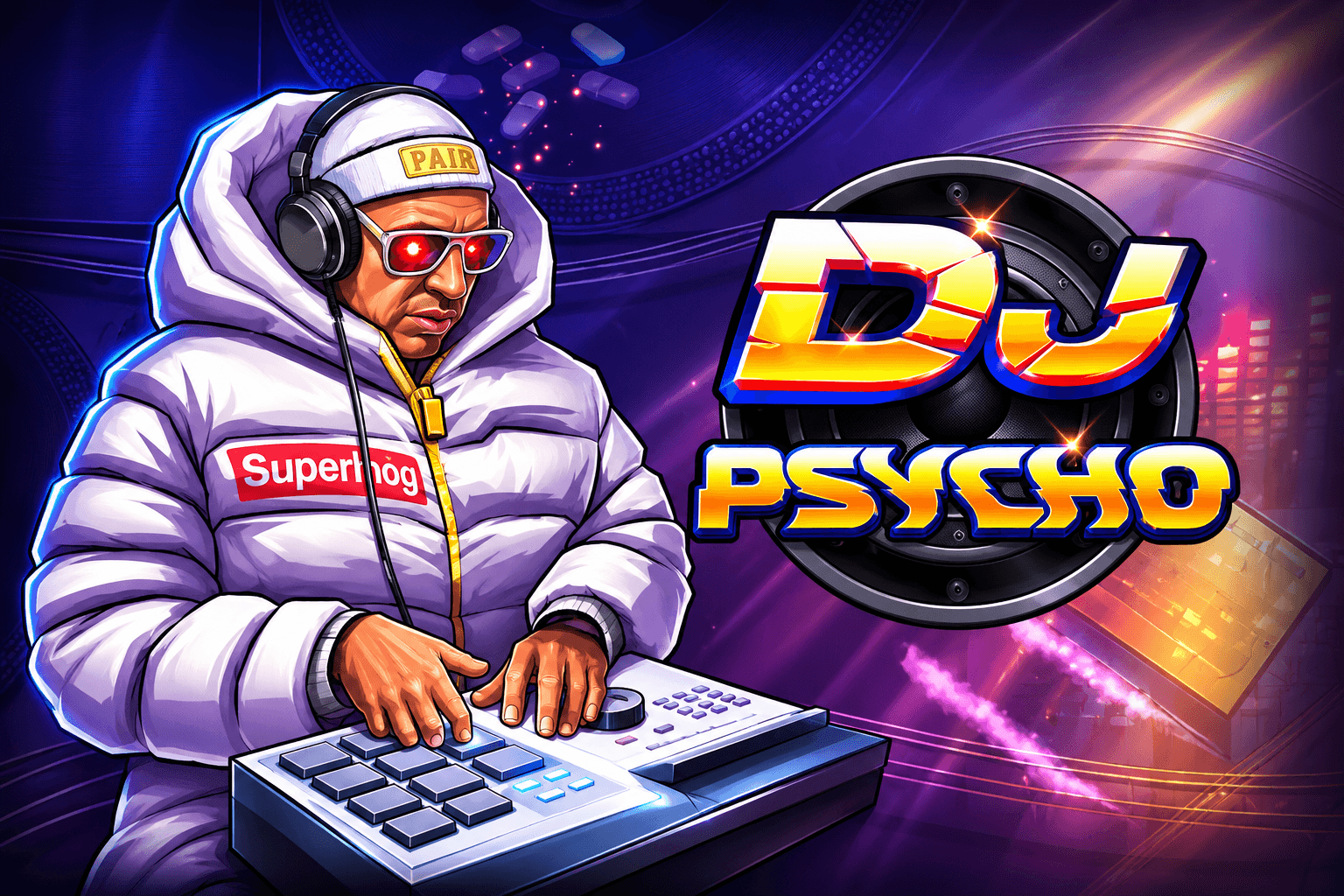
DJ Psycho Free Demo: A Four-by-Four Club of Changing Symbols
DJ Psycho is a Nolimit City video slot released on 22 August 2023. Its setting resembles an unruly underground electronic-music venue rather than a conventional casino floor: glowing colour-coded symbols, threatening DJ artwork, an animated sound-system atmosphere and a surprisingly busy 4×4 game area. The demo is an opportunity to learn the rules with a virtual balance. Instead of chasing lines across five reels, watch for connected groups of identical symbols. Winning groups disappear, replacements enter and special icons can transform the remaining board before the round is finished.
The small grid is deceptive. xKnob alters the overall win multiplier, xBPM changes the effective size of symbols along one row, and Break, Bite and Drop give ordinary icons additional identities. The Beat Bar tracks separate progress for different colours and ultimately controls access to Geez Spins and Psycho Spins. Each element has a distinct job. Understanding those jobs is more useful than simply remembering the game's large theoretical maximum payout.
What the free version lets you explore
Start with a few ordinary demo spins and watch the complete round rather than only its final number. A winning cluster can create an avalanche; the newly introduced symbols can form another cluster. During that sequence the Beat Bar may change, feature icons may appear and a Crossed Symbol may acquire an additional value. The virtual balance makes it possible to experiment with different interface options without adding funds. Availability and the precise menus depend on the demo provider and the version loaded.
Dark club artwork with a technical game underneath
The colourful lights and aggressive DJ characters establish the theme, but the most important on-screen indicator is the Beat Bar. Its colour markers matter more to the rules than the cosmetic effects. DJ Psycho rewards careful reading of a small space: one tile can belong to a horizontal or vertical cluster, while a transformed tile may count as more than one symbol type. Use the paytable or help menu inside the demo to distinguish paying symbols from modifiers.
How Cluster Payout Works on the 4×4 Grid
There are four reels and four visible rows, for sixteen positions at the start of a spin. DJ Psycho uses Cluster Payout rather than fixed paylines or left-to-right Ways. A cluster pays when at least three symbols of the same paying type touch horizontally or vertically. The matching positions must form a connected group; simply displaying three similar pictures somewhere on the grid is insufficient if they are separated.
Connected symbols, not diagonals
Imagine three identical icons arranged like a corner: two side by side and one directly below one of them. All three touch by an edge, so they are one cluster. Now imagine the same icons scattered in three corners of the grid, with no shared edges. That arrangement is not a winning cluster. Diagonal proximity by itself does not join icons into a cluster, even though other features of the game can affect diagonally positioned symbols.
Avalanches keep a round moving
Once a cluster wins, its participating symbols are removed and other symbols enter the spaces. The new arrangement can pay again without starting an independent paid spin. This repeated removal-and-replacement process is referred to as an avalanche. Several winning evaluations can therefore occur inside one round. The sequence ends when the board no longer creates a qualifying payout and no remaining special effect continues it. Each displayed result should be understood as part of the same round until the game completes its resolution.
Why transformations matter for clusters
A normal symbol contributes to a matching group only when it has the required identity. A Crossed Symbol can carry two symbol values and therefore has additional possibilities for connecting to neighbours. Wild symbols can help substitute for paying symbols as permitted by the game's rules. That does not guarantee that a modified tile will form a win: the surrounding layout still has to meet the connectivity requirement. A tiny grid can support a surprisingly large variety of outcomes when these effects overlap.
Crossed Symbols: Two Values on One Position
Crossed Symbols are one of DJ Psycho's signature ideas. A suitable paying symbol that is transformed gains a second symbol value. The developer distinguishes medium-paying and low-paying symbol groups: the initial transformation adds a value from the corresponding group. The result is no longer just the original tile in the ordinary sense. One position may participate in cluster evaluation through either of its displayed identities.
The first transformation
Look for the visual indication that a tile has become crossed. This does not mean the entire board suddenly doubles in value. It means that the transformed position now presents two symbol identities. Whether that helps depends on which other icons it can touch. A cluster of the added value might become possible even where no matching cluster existed beforehand. The feature is about flexibility in matching, not a guaranteed fixed payout multiplier.
The second transformation produces a Wild
If a newly Crossed Symbol is transformed again, it becomes Wild. That escalation makes repeated modifiers particularly important. A symbol affected once by Break can later be affected again by Bite or another qualifying transformation; if the conditions are met, the second transformation is the meaningful upgrade. In the demo, track a single tile across an avalanche to see whether its identity changes before or after neighbouring clusters disappear.
Break, Bite and Drop: Three Different Patterns
The three named transformation icons should not be confused. They all modify symbols, but their target areas differ. Learning the geometry of each effect helps explain why some rounds develop across the board while others modify only a narrow path.
Break affects adjacent positions
Break applies an added selected symbol value to itself and its orthogonal neighbours: the tiles directly left, right, above and below, where those positions exist. It therefore creates a cross-shaped target pattern. Near an edge or corner fewer neighbouring positions are available. It may produce Crossed Symbols from medium- or low-paying icons, and a later eligible transformation can turn a crossed icon into Wild.
Bite reaches diagonally
Bite applies the added value to itself and its diagonal neighbours. These are the corner-touching positions, not the straight horizontal and vertical directions used by Break. This distinction matters because a Bite modifier might change a tile that was not part of a current paying cluster at all. The changed tile could become useful when an avalanche rearranges symbols around it. Bite's diagonal target pattern should never be confused with the game's basic rule for clusters, which requires edge contact.
Drop needs a pair
A lone Drop symbol does not activate its transformation. The developer describes it as a dead symbol unless a second Drop appears. When two Drop symbols land, the shortest path between them is selected and the symbols along that route are transformed to include a second value. A paired Drop can therefore reach positions that a single Break or Bite could not affect. The exact path becomes visible through the game's animation; do not presume the same route will appear every time.
xKnob and xBPM: Different Ways of Helping a Win
Both xKnob and xBPM become Wild symbols when they land, but their additional roles are not interchangeable. xKnob is tied to a general multiplier, whereas xBPM changes symbol size within a particular row.
xKnob and the general multiplier
The official Game Sheet specifies that xKnob contributes a minimum increase of +1 to the overall win multiplier. That multiplier affects wins rather than simply adding an extra picture to the grid. The precise outcome of a round depends on whether qualifying clusters occur and on any other active effects. In Psycho Spins, the achieved general multiplier is sticky, making the timing of an xKnob especially significant during that mode.
xBPM expands the row effect
When xBPM lands it converts to Wild and multiplies the size of each symbol on its particular row by two. This is a row-specific transformation. It is not the same as doubling the entire game's stake or applying a universal 2× prize multiplier. Observe how the affected row changes visually and then how the cluster evaluation uses the modified symbols. A simple-looking 4×4 space can behave differently once a feature changes what occupies an individual position.
Reading overlapping effects
A busy round may combine a Crossed Symbol, a Wild and multiplier progress. The most reliable way to interpret it is to identify the modifier first, then the group of paying tiles and finally the displayed win calculation. The symbols' roles happen at different stages. Treating every feature as a generic multiplier would obscure the actual mechanics of this particular game.
The Beat Bar Controls Progress Toward Bonuses
The Beat Bar is central to DJ Psycho. It records progress for the coloured paying symbols. Whenever a coloured symbol connects, the multiplier associated with that particular colour increases by one. These colour-specific levels are separate from the overall multiplier provided by xKnob. Watching both indicators is important because they have different effects.
What is retained during an avalanche?
The developer says that Beat Bar progress is sticky during avalanches and bonus modes, until a new bet is made. In the base game the indicator resets for a new independent round. This is why a single extended avalanche can be more important than an isolated cluster: repeated matching within the same round can build the colour indicators. However, progress should not be assumed to continue indefinitely through unrelated base-game spins.
Selected colours for free spins
On each base-game spin the game selects from one to five colours as potential free-spin triggers. A colour reaching the relevant multiplier is not by itself a complete description of the trigger: the colour must also be activated for free spins on the Beat Bar. This distinction explains why similar-looking cluster sequences may have different bonus outcomes. The active colours are shown in the interface rather than selected by the player through a deterministic strategy.
Geez Spins: Reaching the First Threshold
Geez Spins are the first main free-spin mode. According to the Game Sheet, a chosen and activated colour reaching a 3× Beat Bar multiplier in the base game triggers five initial free spins. The key point is the combination of the colour's x3 progress and its active trigger status. Neither a traditional Scatter trio nor a fixed payline is required for the mechanism described by Nolimit City.
Starting with five spins
The five-spin starting count is a property of the natural Geez Spins trigger. It is useful to contrast this with bonus-purchase illustrations that may display different starting amounts. In the free demo, follow the counter in the actual mode you have entered rather than assuming that every menu or entry path must show identical numbers.
Extra spins from additional colours
During Geez Spins, reaching a 3× multiplier for another coloured symbol awards two additional spins. This gives different colours an ongoing role in the bonus. The Beat Bar is therefore not just a launch mechanism: it continues to organise progression while the feature runs. A free-spin sequence can extend if the stated conditions are met, but the rules do not promise any particular extension.
What changes while Geez Spins is active?
The progress markers stay in play for the feature, so transformations and repeated clusters can help advance further colours. It becomes possible to approach the stronger Psycho Spins threshold without abandoning the same system of connected tiles. Keep an eye on all colour markers, not only the one that originally unlocked the free spins.
Psycho Spins: The Five-Colour Goal
Psycho Spins is the advanced mode. If all coloured symbols reach a 5× multiplier during Geez Spins, the game upgrades to Psycho Spins. There is also a direct route described by the developer: reaching the 5× threshold for all colours through the base game grants 17 Psycho Spins. That figure describes the stated natural base-game entry, not every possible purchased version of the feature.
Sticky general multiplier
In Psycho Spins the overall multiplier becomes sticky. Unlike a simple temporary modifier that disappears immediately after an evaluation, the achieved general value persists during this bonus as specified by the rules. The xKnob symbol therefore has an especially visible role. Check the main multiplier display separately from the five colour tracks on the Beat Bar; both may be important during a large avalanche.
A feature symbol after a hit
Nolimit City says that any hit in Psycho Spins guarantees a feature symbol in the next avalanche. This is a conditional guarantee associated with a hit, not a guarantee that every free spin or every avalanche will pay. It creates a recognizable chain: a paying cluster resolves, the board changes and a new modifier can enter the following drop. The free demo is useful for seeing the sequence slowly before trying to interpret the final total.
What happens at the payout cap?
The game includes a Remixed maximum payout of 25,420 times the base bet. When a round reaches or exceeds this limit, the round ends and the capped amount is awarded. The maximum is a theoretical upper bound, not a typical result. The official Game Sheet estimates its occurrence at approximately one in 37 million spins for the 96.05% RTP version.
Boosted xBet and Nolimit Bonus: Optional Menus
DJ Psycho has two kinds of optional entry choices described in the Game Sheet. These menus concern wagering configurations rather than a requirement for demo play; availability can depend on the operator, local regulations and demo implementation. If the demo exposes them, they are useful for recognizing how the game labels its modes.
Boosted xBet
Boosted xBet adds 235% to the base stake, making the total 335% of the ordinary stake. The official figures describe Geez Spins as three times more likely and Psycho Spins as more than seven times as likely under this option. The boost does not apply to bonus modes and does not alter the payout value assigned to each paying symbol. It changes entry frequency, not the fundamental way clusters are calculated. At the highest stated base stake, the total with xBet reaches 335 units of the relevant currency.
Bonus Buy options
The official Game Sheet lists feature buys at 50× for Geez Spinz, 77× for Lucky Draw 1, 209× for Lucky Draw 2 and 420× for Psycho Spinz. These are separate optional menu entries. They are not necessary to understand or access ordinary free demo spins, and some regulated markets remove the purchase feature entirely. Do not confuse the free-spin counters shown in a purchase illustration with the counts for the naturally triggered Geez or Psycho modes.
xCluster and general feature labels
The publisher's game page also lists xCluster as a game mechanic: two or more distinct symbol clusters in the same avalanche may increase the win multiplier by one for each additional unique cluster beginning with the second. Because the detailed game sheet emphasises the named DJ mechanics instead, the exact on-screen activation should be checked in the actual help menu if xCluster appears. The broader xBet label on the website describes paid frequency boosts in general; the specific DJ Psycho figures come from its own feature description.
RTP, Volatility and Statistical Limits
The standard game configuration has a theoretical return to player of 96.05%. Other publisher-listed configurations are 94.09% for DX1, 92.08% for DX2 and 87.04% for DX4, which is marked for the German market only. The version that actually loads in a particular region may not match the main promotional number. The correct reference is the in-game information for that version.
What does medium volatility mean here?
Nolimit City rates DJ Psycho at 6/10, described as medium volatility. That sets it apart from many extremely volatile games in the developer's catalogue, but medium does not mean a consistent profit or a guaranteed win every few rounds. The game's theoretical ceiling is still very high and exceptionally rare. Large and small outcomes can occur at uneven intervals, and the demo's virtual balance does not predict the behaviour of future sessions.
Hit frequency and free-spin frequency
The publisher gives a 39.54% hit frequency and an average free-spin frequency of one in 147. It also lists a win exceeding 100 times the stake at approximately one in 997. These are long-run model figures, not a timetable. They should not be read as a promise that the next spin after a particular losing sequence is due to pay. Free demo spins do not reset or manipulate the mathematical probabilities in the user's favour.
RTP components and rare maximum
The Game Sheet allocates 54.35% of theoretical RTP to base play and 41.70% to bonus modes in the standard configuration, which together make 96.05%. That breakdown is useful for understanding why bonus activity contributes materially to the overall model. It does not mean that any single game session will split wins in the same proportions. The maximum 25,420× is assigned a probability around one in 37 million for the standard RTP, underlining how different a possible extreme payout is from ordinary play.
A Practical First Session in the Free Demo
Begin with the default virtual stake and check that the game has loaded with the intended language. Open the help panel, then identify the sixteen positions and the cluster rule. On a spin with no winning group, observe how the board ends promptly. On a spin with an edge-connected match, watch the removal and replacement animation. That distinction forms the foundation for understanding the more complex features.
Look for one modifier at a time
When Break appears, follow its vertical and horizontal neighbours. When Bite appears, switch your attention to diagonals. If a single Drop appears, note that it needs a second Drop to activate. Whenever a Crossed Symbol is transformed again, check whether it has become Wild. Separating those cases avoids treating all glowing animations as the same action.
Keep the two types of multipliers separate
The Beat Bar's colour multipliers help activate Geez Spins and Psycho Spins. The xKnob changes the general multiplier on wins, with a sticky effect in Psycho Spins. The difference is easy to miss when several indicators rise simultaneously. Focus on the colour thresholds x3 and x5, then on the main multiplier, and finally on the count of remaining spins if a bonus begins.
Understand what a short test cannot show
A short demo visit may show only basic clusters and no rare features. That does not disprove the published mechanics; it simply reflects a small sample. Neither a lengthy losing spell nor a series of wins is evidence of a predictable next outcome. Demo play is most useful for learning controls, watching how effects resolve and deciding whether the game's busy presentation is enjoyable.
DJ Psycho Frequently Asked Questions
Can I play DJ Psycho without a deposit?
A working demo version uses virtual funds, allowing players to explore the slot without depositing money. Actual availability depends on whether the demo host supplies the game in the visitor's location.
How many reels and paylines does it have?
DJ Psycho uses a 4×4 grid with no conventional paylines. Three or more matching paying symbols must form an edge-connected cluster, which is removed after a payout.
Do diagonal matches count as clusters?
No. Cluster Payout requires horizontal or vertical contact. Bite affects diagonally positioned tiles, but that transformation pattern does not change the ordinary cluster connection rule.
What triggers Geez Spins?
In the base game, a colour selected as an active free-spin trigger must reach x3 on the Beat Bar. The natural trigger awards five initial spins. Additional colours reaching x3 during Geez Spins can award two more spins each.
How do Psycho Spins begin?
All coloured symbols need to reach x5 during Geez Spins for an upgrade. Reaching x5 on every colour through the base game is described as awarding 17 Psycho Spins directly.
Is there a Scatter symbol?
The official game feature descriptions emphasise the Beat Bar and selected colours rather than a standard Scatter trigger. Do not infer a conventional three-Scatter bonus merely because other slots use one.
What is the maximum win and RTP?
The theoretical maximum is 25,420× the base bet. Standard RTP is 96.05%; alternative versions have other values. The maximum is very rare, so it should not be treated as a likely demo outcome.