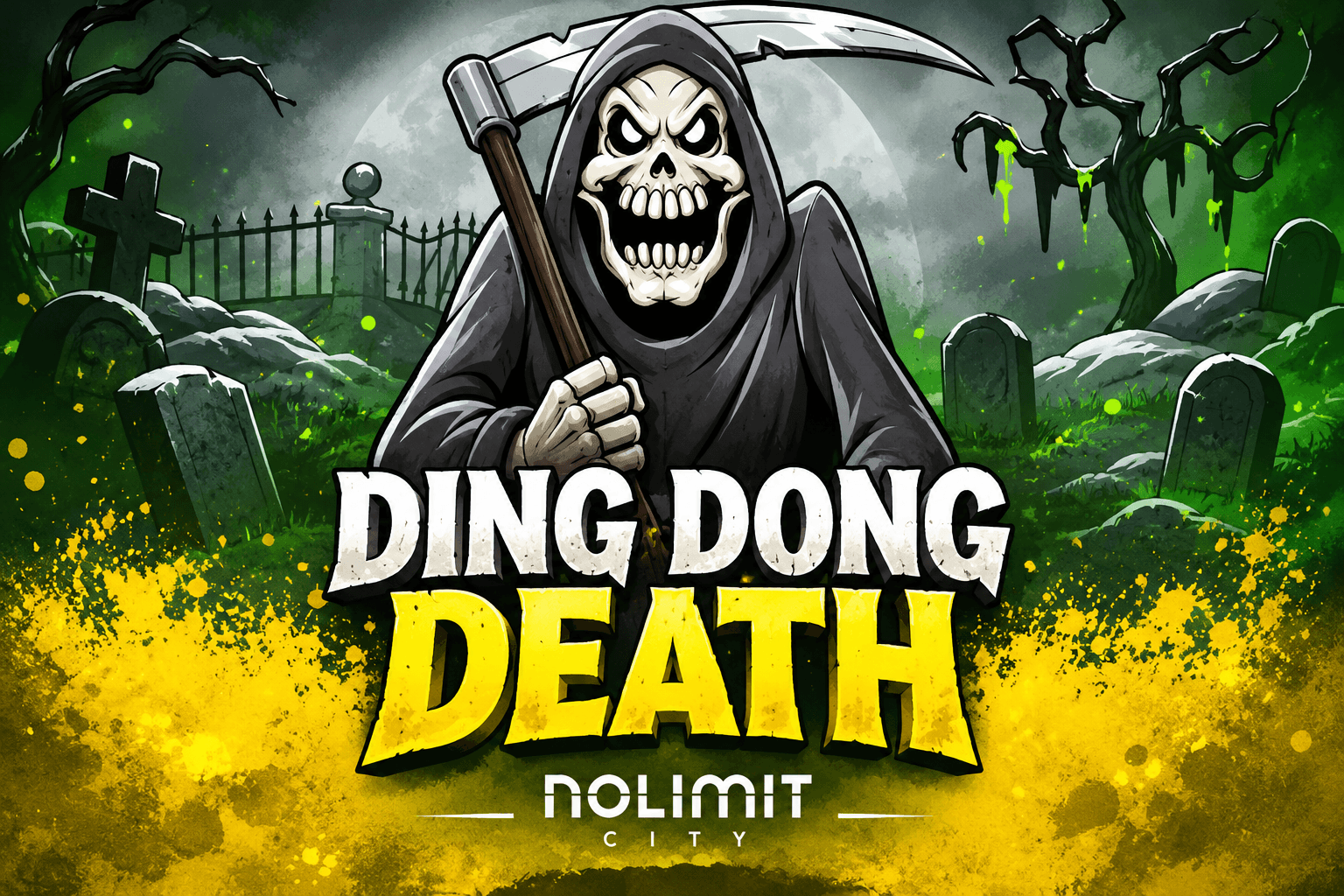
Ding Dong Death free demo and game overview
Ding Dong Death is a darkly comic six-reel video slot from Nolimit City, released on 22 September 2026. Its oddball graveyard clubhouse brings together familiar character types in a game built around falling symbols, a five-level Death Meter and two related free-spin features. Rather than treating every spin as a single result, the game lets a chain of symbol collapses develop inside one round. As that chain grows, characters can change into Wilds and the shared multiplier can become increasingly important. The free demo is an accessible way to understand that sequence before trying to interpret the more complicated bonus displays.
The starting grid has six reels with three symbol positions on each reel. The headline figures published by the developer are a 96.08% theoretical return to player, a 20.02% hit frequency, an extremely high volatility classification and a maximum payout of 14,280 times the base bet. The advertised range is 0.20 to 100 in the relevant currency. These numbers describe the game model; they do not predict the outcome of a particular demo session. The official average frequency for the free-spin feature is about one in 282 spins, which is not a schedule or a promise that a bonus must appear within that number of attempts.
This guide explains the board, the way avalanches feed the meter, how Knock Knock differs from an ordinary winning match, and what changes between Ding Dong Spins and Ding Dong Death Spins. Optional booster and xTra Spin controls are also explained as interface features, not as requirements for enjoying the free version. If an option is absent from the version that loads in your browser, its availability may depend on the build or region.
How a normal round works
A six-reel board with collapsing symbols
Ding Dong Death displays three rows across six reels. A round begins when the reels settle into a symbol arrangement. A qualifying win pays according to the active game rules, after which the winning symbols are cleared and other symbols collapse into their places. Fresh symbols enter the empty spaces, and the updated arrangement is checked again. This can create a further result without starting a completely new paid spin. The developer calls these continuing drops avalanches.
An avalanche is more than a visual effect. Each one contributes toward unlocking the Death Meter, so a sequence of successive drops can change the possibilities of the same round. When learning the demo, watch the order of events: the original reel result, the cleared symbols, the new arrangement, and then the meter. If two things seem to happen almost together, the animation can make them hard to separate, but their relationship becomes easier to see over several spins.
How winning ways interact with Wilds
The game uses winning ways rather than inviting players to select a set of classic fixed paylines. Matching payable symbols must be recognized by the game along the reel layout; simply seeing several identical pictures on screen does not necessarily mean a winning combination has formed. Wilds can participate in eligible wins by substituting for normal symbols. The official rules specifically state that a Wild does not substitute for a Scatter.
An xSplit Wild can change how many symbol positions participate in an evaluation. That is why the potential number of winning routes is not best described as one immutable number in this guide. On an active round, first identify whether a Wild is present and then look for a split or conversion before reading the final displayed award. The game's own win presentation is the definitive explanation of the evaluated combination.
Death Meter explained
Every third avalanche moves the meter
The Death Meter contains five levels and appears during ordinary play as well as in the bonus modes. Each third avalanche unlocks a level. When a level is unlocked, the game converts all instances of a designated character-symbol type into Wilds for the remainder of that round. This conversion is the important part: the meter is not simply a counter that awards a separate prize when it fills. It changes the symbols available for further cascades and may help create additional connections.
The phrase “for the remainder of the round” matters. Do not assume that all conversions will remain active when an unrelated new base-game spin begins. Likewise, do not confuse the meter's continuing activity during a free-spin feature with a permanent upgrade across unlimited normal spins. In the demo, look for which character becomes Wild at each unlocked level and how any subsequent avalanche uses those substitutions.
What happens at Level 5
In the standard game behavior, unlocking Level 5 starts the global win multiplier at x2 the first time it is unlocked. Every later Level 5 unlock increases that multiplier by one. The game may also launch a special modification at this point. After one of the described Level 5 features triggers, Level 5 becomes locked again, allowing the progression to be approached anew. Reaching the final level is therefore not necessarily the end of the meter's usefulness.
Three different enhancements are associated with this advanced stage: Mental Patient, xSplit Wild and xNudge Wild. They affect the board in different ways. One changes a low-paying symbol family, another splits positions across a row, and the third introduces a moving Wild with its own multiplier. Separating those outcomes prevents a common misunderstanding that every Level 5 event has the same effect.
Global multiplier versus individual Wild multiplier
The global win multiplier and the multiplier carried by an xNudge Wild are not interchangeable. The global value is part of the broader round state and grows when the specified meter conditions are met. An xNudge value is associated with the Wild itself and only applies to winning combinations that actually involve it. In the advanced Ding Dong Death Spins feature, there is an additional interaction between the two, which makes it essential to know which free-spin mode is running.
A useful demo habit is to notice where each number is displayed before checking the winning total. A multiplier painted onto a symbol is not automatically a global multiplier, and a global number does not mean every visual symbol on the grid is now a Wild. Read the individual effect before assuming that two impressive-looking numbers will be multiplied together.
Wild symbols and the xMechanics
Regular and Character Wilds
A regular Wild substitutes for an eligible paying symbol, but not for a Scatter. Character Wilds can appear as a result of Death Meter transformations. When the meter changes all examples of one character type, the board may suddenly contain multiple Wilds of a visually related design. That provides a possible bridge to another win or avalanche, but the transformation itself is not a promise of a payable combination.
Wild conversion matters especially toward the later stages of a continuing round. A set of otherwise unhelpful character symbols may become valuable only after the meter advances. The order of conversion, collapse and reevaluation is central to understanding the game and much more informative than looking only at the final payout figure.
xNudge Wild: falling, expanding and adding multipliers
An xNudge Wild drops to the lowest position on its reel. As it passes over symbols during that drop, its payout multiplier rises by one for each passed position. After reaching the bottom, the Wild expands to fill the reel. During that expansion upward, only split symbols increase its multiplier. This is a precise distinction: the downward movement and the upward expansion do not use exactly the same increment rule.
When consecutive xNudge Wilds participate in a win, their relevant multipliers are added rather than automatically multiplied. For example, the developer illustrates a x3 and x1 combination resulting in x4. That resulting value applies to a win involving the xNudge Wild, not to every payout anywhere in the scene. In a crowded bonus round, tracking which Wild is part of which combination is therefore more useful than simply adding all visible numbers.
xSplit Wild: doubling positions within a row
A Level 5 event can turn one or more Character Wilds into xSplit Wilds. Each xSplit Wild splits and doubles symbols in its row, with Scatter symbols excluded from that doubling. The effect can increase the set of symbol positions considered when the game evaluates wins. If an xNudge Wild is itself split, its multiplier is doubled. These are distinct consequences of the same splitting mechanic.
The familiar xSplit branding appears across other games from the developer, but the relevant behavior here is what Ding Dong Death actually describes: a split affecting the row and the eligible symbols in it. Do not carry over bonus rules or Scatter transformations from a different title merely because the symbol name looks familiar.
Knock Knock feature
Three matching symbols can trigger something other than a win
Knock Knock is a separate board event. During the main game, it can trigger when three or more identical symbols appear in a horizontal alignment but do not form a winning combination. The triggering symbols are removed, and the middle positions of that alignment become Mental Patient symbols. This unusual trigger matters: it responds to a particular non-winning arrangement, not just to any three matching icons.
The effect can set off further movement. Symbols other than the protected Scatter, Wild and Mental Patient types explode, which initiates another collapse. If a position replaced in the middle already carries a multiplier, that multiplier transfers to the new Mental Patient symbol. The transfer rule means the feature can preserve a value that would otherwise be easy to overlook during the explosion animation.
Reading Mental Patient transformations
The Mental Patient effect can also appear among the Death Meter Level 5 outcomes. In that case the game randomly selects a low-paying symbol and transforms that symbol type, including its instances, into Mental Patient symbols. The Level 5 selection is not identical to the horizontal Knock Knock trigger, even though the resulting character label is shared.
For demo learning, look at what caused the transformation. Was there a horizontal non-winning alignment, or did the Death Meter reach its final level? The answer tells you which rule has just operated and helps prevent the game from looking like a collection of arbitrary surprises.
Scatter symbols and free-spin entry
Three, four or five Scatters start Ding Dong Spins
Landing three Scatters awards seven Ding Dong Spins. Four Scatters award nine spins, while five Scatters award eleven. During this feature, the Death Meter and global win multiplier are not reset as the bonus sequence progresses. Another Scatter appearing during the feature grants one extra spin. This continuing progress is one of the main reasons the free-spin mode feels different from isolated base-game rounds.
The initial number of awarded spins depends on the number of triggering Scatters, not on a general assumption that all bonuses start at the same length. A longer initial feature gives more chances for avalanches to build meter levels, but it does not guarantee additional Wilds, a particular multiplier or a large payout.
Six Scatters start Ding Dong Death Spins
Six Scatters activate the enhanced Ding Dong Death Spins and award thirteen initial spins. The ordinary Ding Dong Spins feature set remains active, but the multiplier rules become stronger and more direct. Each newly unlocked Death Meter level increases the global win multiplier by one, rather than reserving the standard global change for Level 5. In this mode, unlocking Level 5 also adds one, instead of applying the ordinary first-time x2 treatment.
There is another important difference. The multiplier from an xNudge Wild involved in a win is added to the global win multiplier. This interaction is specific enough that it should not be copied into a description of ordinary base-game spins. The enhanced bonus is therefore not just Ding Dong Spins with two extra starting spins. It changes how meter progress and Wild multipliers contribute to the result.
Comparing the two bonus modes
What stays the same
Both bonuses retain the fundamental six-reel layout, collapsing symbols, Wilds, Death Meter progression and the possibility of extra spins when Scatters appear. In both, a single successful avalanche sequence may unlock additional levels that change symbol types. The game's central identity does not disappear just because the free-spin banner has changed.
What actually changes
The ordinary Ding Dong Spins feature begins with seven, nine or eleven spins depending on three, four or five Scatters. Its global multiplier follows the standard Death Meter Level 5 behavior. Ding Dong Death Spins begins with thirteen spins when six Scatters appear. Here every unlocked Death Meter level boosts the global number, and a winning xNudge Wild can feed its own multiplier into that global value. Those two differences—not simply the number of spins—are the easiest way to understand the higher-intensity mode.
Neither mode should be evaluated only by its starting spin count. An apparently shorter bonus can still have several productive avalanches, while a longer one can pass with relatively few meaningful connections. The demo is well suited to observing this contrast because results have no cash value.
Optional boosters and xTra Spin
Boosters change the starting conditions
The official game description lists a Bonus Booster that costs twice the base bet and makes the free-spin modes three times more likely to trigger. It also lists Death Meter 3, Death Meter 4 and Death Meter 5 boosters at fifty, one hundred and two hundred times the base bet respectively; those options guarantee reaching the stated meter level. Such guarantees concern the specified feature condition, not a guaranteed positive payout.
An xNudge Booster is described as another optional route, but official promotional and current game-page descriptions disagree about its exact price and guaranteed behavior. For this reason, this guide does not assign a fixed numerical cost to that option. Consult the help panel of the particular demo build if the control is displayed. The free game can be explored without choosing a booster, and it is often easier to learn the unmodified reel behavior first.
xTra Spin preserves progress when offered
The xTra Spin option may appear at the end of a round. It offers an additional spin that keeps the previously reached Death Meter levels and global win multiplier. The game calculates the proposed cost from that state, and the offer is only presented when the cost is no greater than the total win. There is no single published xTra price that applies to every situation.
This is not the same as a free automatic continuation. It is a conditional extra-spin offer, and players using a demo should treat it as an optional way to see how retained progress affects another round. If the prompt does not appear, that alone does not indicate the demo is broken; the required conditions may simply not have been met.
Game maths and volatility
RTP, hit frequency and bonus frequency
The developer displays 96.08% RTP for Ding Dong Death. Return to player is a long-run theoretical percentage over the game model, not the portion that each player receives back. The official hit frequency of 20.02% is a separate statistical measure and should not be confused with the chance of entering free spins. The published free-spin frequency is about one in 282 spins. These figures describe different events and cannot be turned into a reliable forecast for the next ten or twenty demo spins.
The provider categorizes the game as extremely volatile. That means the shape of returns is expected to be uneven, with outcomes capable of being highly concentrated rather than smoothly distributed. A quiet sequence in the demo is not proof that a bonus is due; similarly, a large virtual win does not make another large win more likely. Each game result is evaluated under its own rules.
Maximum payout and its probability
The maximum advertised result is 14,280 times the base bet. The official game page gives an approximate maximum-win probability of one in five million. Once a round reaches the maximum permitted cumulative payout, the round ends and the maximum amount is awarded. A visible avalanche or bonus feature does not continue indefinitely past that cap.
The cap is useful for interpreting demonstrations of the game's potential, but it is not a realistic target for a short trial. The enormous difference between an average frequency and a headline maximum probability illustrates why demo sessions are better used for understanding the interface and mechanics than for trying to prove the mathematics.
How to play the demo and learn its features
Start with the ordinary mode
Open the demo, let it finish loading and inspect the information menu if available. Check the RTP and rules displayed by the active version, then select a comfortable virtual stake and watch a few normal rounds. Pay attention to which symbols disappear, how new ones drop in and when the Death Meter advances. If the screen offers animation speed controls, a slower setting may make the first few demonstrations easier to follow.
Do not judge a round only by the initial reel stop. Some of the game's interesting action arrives after the first collapse, and an absence of an initial paid win does not rule out Knock Knock. The more useful question is what triggered each movement and which state, if any, carried over into the remainder of that round.
Observe one bonus from beginning to end
When a Scatter-triggered feature appears, identify whether it is Ding Dong Spins or Ding Dong Death Spins. Note the starting number of spins and watch for extra spins awarded by later Scatters. Observe when the global multiplier increases: only on the ordinary Level 5 progression in one mode, or on each unlocked level in the enhanced mode. If an xNudge Wild lands, check whether its multiplier is local to a winning combination or contributing to the global total in the enhanced feature.
The game is visually dense, so it is reasonable to watch the same animation rule across several rounds rather than trying to track everything at once. The combination of Wild transformation, splitting and avalanches becomes clearer when each feature is understood independently.
Common questions about Ding Dong Death
Is the demo free and can its wins be withdrawn?
The free demo uses virtual play. It is intended for exploring the rules and animations without staking real funds. Displayed demo balances and prizes are not cash that can be withdrawn. Exact access to the demo, optional controls and available game versions may vary by the service that embeds the game.
What is the main difference between Wild and Scatter?
Wild substitutes for eligible paying symbols but never for Scatter. Scatter symbols are used to trigger the free-spin features, with three to five starting ordinary Ding Dong Spins and six starting Ding Dong Death Spins. They have different functions even when both appear in the same round.
Is reaching Death Meter Level 5 guaranteed to produce a large win?
No. Reaching the level activates the specified multiplier behavior and may trigger an additional feature, but an award still depends on the resulting symbol combinations and rule evaluations. The meter changes the possibilities of a round; it does not override the game mathematics.
Does xNudge multiply every win on the board?
No. Its multiplier applies to wins involving the xNudge Wild. When multiple consecutive xNudge Wilds participate, their relevant values are added. Ding Dong Death Spins introduces a special rule that can add the participating Wild multiplier to the global win multiplier.
Does the 96.08% RTP guarantee a particular demo result?
No. The percentage is theoretical and long-run. The playable version should be checked in its own help menu, and no short sequence can be expected to match that exact percentage. The free demo is most useful for learning how avalanches, the Death Meter, Knock Knock and the two bonus features work together.
Final overview
Ding Dong Death combines an unusual cast of characters with a clear chain of mechanical ideas: wins produce avalanches, avalanches advance the Death Meter, the meter changes characters into Wilds, and later stages can add powerful transformations and multipliers. Knock Knock adds a separate trigger to otherwise non-winning horizontal alignments. The two free-spin features preserve the central formula but reward meter progress in different ways. In the free demo, the most rewarding thing to study is not the size of a virtual win, but how the screen moves from one stage of that chain to the next.