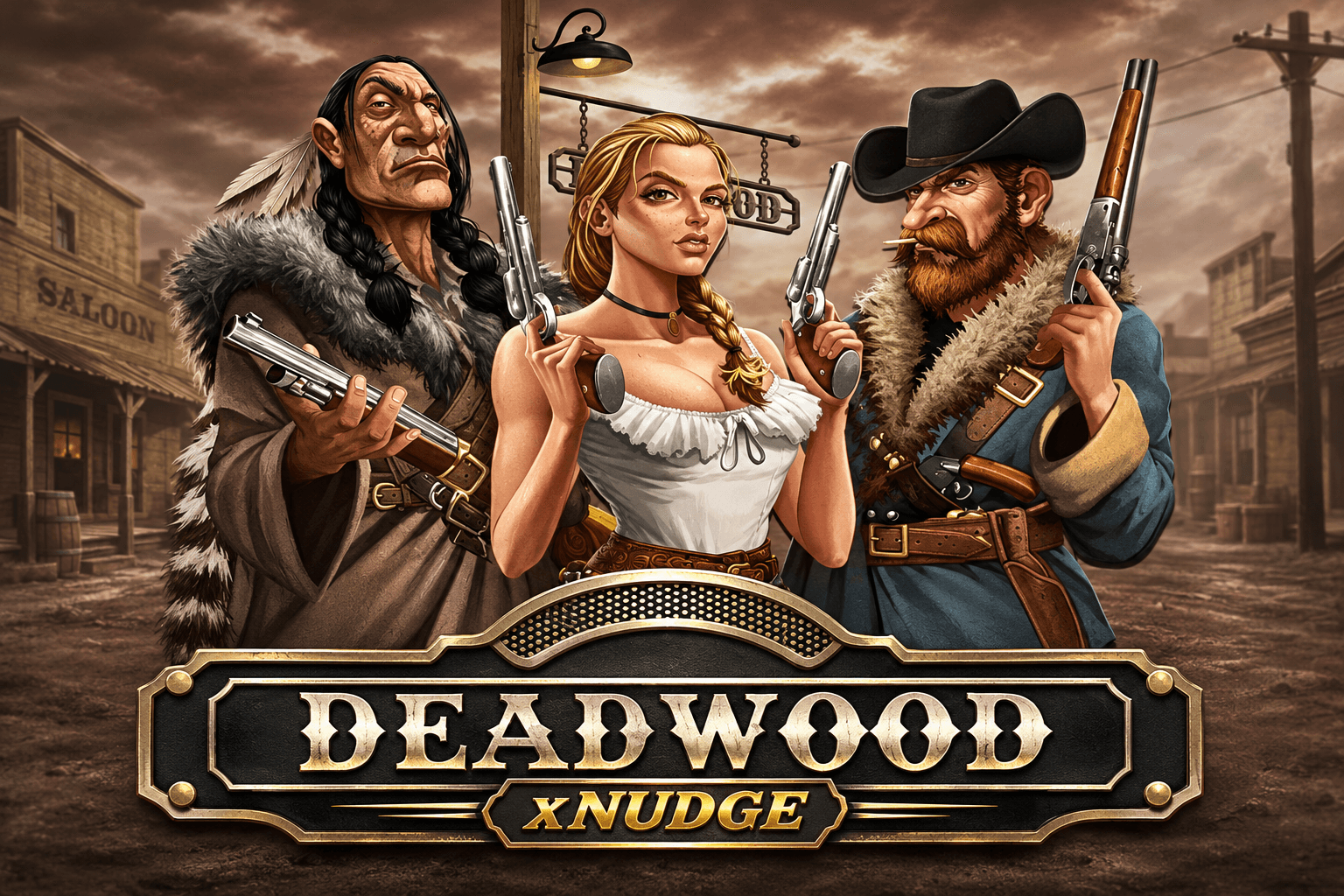
Deadwood xNudge is a five-reel western-themed slot by Nolimit City, released on 6 May 2020. Its focus is not on complicated symbol collections or a long chain of unrelated mini-games. One clear idea drives the action: a tall Hunter Wild moves into full view and gains a larger win multiplier with every nudge. Add a second Hunter Wild to a winning combination and their multipliers combine. The free demo is an accessible way to see this unusual movement, read the result on the reels, and compare two genuinely different bonus modes without using real money.
The game takes place among bounty hunters, gunfighters and sheriff badges in an outlaw town. Behind the grim character art is a precise structure: five reels with 3, 4, 4, 4 and 3 visible positions, providing 576 ways to win. Three Scatter symbols can start a choice between Hunter Spins and Gunslinger Spins; sheriff badges can introduce the Shoot Out modifier. Each feature changes something specific, so it helps to understand the basic spin before moving into the bonus selections.
Play Deadwood xNudge for free
To begin, launch the demo player on this page and use the virtual balance displayed by the game. Pick a stake from the amounts available in that demonstration, start a spin and watch the five reels settle. When a tall Wild lands partly outside the visible window, observe it nudging into view and increasing its multiplier. This movement is the signature of Deadwood. There is no need to deposit or register to understand the feature inside the accessible demo.
A useful first session involves watching several ordinary spins rather than immediately chasing a feature. Identify the low-value playing-card symbols, the higher-paying character pictures, the tall Hunter Wild, the Scatter icon and the two Sheriff badges. The symbols do different jobs. Ordinary symbols form the basic wins; Wilds can substitute and multiply a qualifying combination; Scatter icons select a free-spin mode; the paired badges activate Shoot Out. The demo's help or paytable screen should be the final reference for the version currently running.
What you can learn without spending money
A free spin still follows the game's actual sequence of animations and rule checks: the Wild comes into view, multipliers grow, ways are evaluated and bonus prompts appear when their conditions are met. Virtual credits let you test whether you understand what happened. For example, after a winning spin that uses two Hunter Wilds, look at the two displayed multipliers and compare them with the total applied to the payout. This is more informative than assuming two multipliers always multiply each other.
Reel layout and the 576 ways system
Deadwood uses five reels with uneven heights: three visible positions on the first reel, four each on the second, third and fourth, and three on the fifth. Multiply these visible positions together and the result is 576 ways. The number describes possible left-to-right paths through the grid, not 576 separate lines that the player must manually select. A conventional fixed-payline diagram is therefore not the best way to interpret the result.
Wins are evaluated from the leftmost reel across consecutive reels. Symbols in different rows can participate in the same way-based combination, provided they satisfy the game's paytable. A fourth matching reel may increase a payout even when the specific symbols are not visually arranged in a straight horizontal line. The precise awards depend on symbol identity and the number of qualifying reels; the paytable within the demo shows the actual values.
Why the 3–4–4–4–3 arrangement matters
The extra positions on the three middle reels provide more space for ordinary matches and for four-row Hunter Wilds. This also creates a useful contrast with the first and last reels, where the Sheriff badge symbols can appear. Keep the two elements separate: the reel heights govern the ways structure, while the Sheriff badges govern the special conversion of low-paying symbols to Wilds. They are related during a spin but they are not the same mechanic.
Some promotional summaries simplify the field to a generic five-reel, four-row grid. The detailed rules and the original game sheet describe the uneven 3–4–4–4–3 configuration. Use that arrangement when reading the diagram or explaining the 576 ways, even if a shortened summary elsewhere labels the layout differently.
Hunter xNudge Wild explained
The four-row-high Hunter Wild is the visual centrepiece of Deadwood. A Wild of this kind does not simply stay in its first visible position. When it appears, it nudges until the full Wild is in view. Each step raises the Wild's multiplier by one. The action creates a small sequence in which the same symbol becomes more valuable as it slides into the final position. The underlying outcome is determined by the game, but the animation makes the mechanic much easier to see.
The Hunter Wild can substitute for paying symbols according to the rules, but it does not substitute for Scatter or Bonus symbols. When several qualifying Hunter Wilds are involved in the same win, their multiplier values are added together. For instance, values of 2× and 3× contribute a total Wild multiplier of 5× to that combination, not 6×. Treat this numerical example as a way to read the addition rule, not as a prediction of what a particular spin will pay.
What a nudge changes and what it does not
A nudge increases a multiplier when the Hunter Wild travels to full visibility; it does not change the number of base ways or guarantee a payout. A visible Wild may participate in a winning combination, or there may be no eligible matching symbols. The free demo lets you distinguish the dramatic Wild animation from the actual win calculation. Always look for the final highlighted winning combinations rather than judging the result by the size of a Wild alone.
In the base game, Wild values are evaluated for the current outcome. Do not assume that an attractive multiplier displayed during one ordinary spin carries forward to the next. Persistent accumulation is a special property of Gunslinger Spins, explained later. Recognising this difference prevents one of the most common misunderstandings when moving from the base game into the free-spin features.
Sheriff badges and the Shoot Out feature
Two Sheriff badges, appearing on the first and fifth reels, introduce Shoot Out. During this modifier the lower-paying card symbols on the three middle reels act as Wilds. This is a conversion effect: it changes the role of symbols already in the central area rather than simply awarding a separate cash prize for a badge. The result can create additional eligible combinations or strengthen ones that already include other Wilds.
Watch carefully when Shoot Out is triggered in an ordinary demo spin. Before the effect, A-through-10 symbols look like normal low-value symbols. After the badges activate it, those symbols behave as Wilds on the middle reels for that event. The modification does not turn Scatter symbols into substitutes, and it is not a permanent change to every future base-game spin.
Shoot Out inside a free-spin round
Both Hunter Spins and Gunslinger Spins can be upgraded to their Shoot Out versions when the two badges arrive together during the bonus. The badges become locked and the central low-value symbols act as Wilds for the upgraded feature. This is a material change to the remaining rounds: the current chosen bonus retains its core Wild rule while Shoot Out adds more substitution opportunities. The names Shoot Out Hunter Spins and Shoot Out Gunslinger Spins describe these combinations rather than completely unrelated bonus games.
Scatter symbols and choosing a free-spin mode
Three Scatter symbols award a free-spin selection in Deadwood. The player can choose between eight Hunter Spins and eight Gunslinger Spins. Both modes start with the same advertised spin count, but they treat Hunter Wilds differently. That choice matters far more to the gameplay than their shared Wild West setting. Learn what each mode guarantees and what it allows to build over time before making the selection in the free demo.
A separate higher-tier start is possible when the three Scatters and both Sheriff badges are present in the qualifying base-game event. According to the detailed game rules, this directly awards ten Shoot Out free spins in the chosen Hunter or Gunslinger mode. In a bonus already in progress, the paired badges can instead upgrade the current round. These are two distinct routes to Shoot Out and should not be described as the same trigger with the same starting spin count.
Hunter Spins: Wild presence on every spin
Hunter Spins begins with eight free spins and guarantees at least one Hunter Wild on each spin. That guarantee concerns the appearance of the special symbol, not the amount of a win. The Wild still needs a suitable combination to contribute a payout, and its multiplier grows through its normal nudging movement. This mode is useful for learning the relation between Wild placement, nudge distance and combination evaluation because the central mechanic stays visible throughout the round.
The detailed rules say each Sheriff badge landing on reels one or five can add one spin. If both arrive together, the mode upgrades to Shoot Out Hunter Spins and the badges lock in place. The low-paying middle symbols then behave as Wilds during the upgraded feature. A demo session with this upgrade shows why adding a conversion effect can be different from merely adding more turns.
Gunslinger Spins: a multiplier that persists
Gunslinger Spins also begins with eight free spins, but its defining property is an accumulating, sticky Wild multiplier. Every qualifying nudge can increase the bonus multiplier, and the increased value persists across the feature rather than resetting with the next spin. The official rules describe the multiplier as unlimited during this mode, even though the overall game still has a published maximum payout for a complete round.
That distinction explains the more volatile profile of Gunslinger Spins. A quiet early sequence may build relatively little, while a sequence with several effective Hunter Wilds may leave a higher multiplier available for later wins. The accumulation alone is not a guarantee that a large payout will occur. You still need winning symbol combinations during the round. A free demo makes it possible to follow the multiplier meter and the credited wins separately.
Sheriff badges behave similarly here: a badge on an eligible outer reel can add a spin, and two arriving together upgrade the current mode to Shoot Out Gunslinger Spins with locked badges. The sticky multiplier and the Wild-conversion effect then coexist. If you only watch the final animation, it is easy to miss which part of the total result came from a persistent multiplier and which part came from extra Wild substitutions.
Understanding the full Shoot Out bonus
Shoot Out Freespins combines the key feature of the selected mode with the additional conversion of low cards on the three central reels. Choosing Hunter means the guaranteed Hunter Wild condition remains central. Choosing Gunslinger means the persisting Wild multiplier remains central. In both cases the Sheriff badges are locked in the upgraded version, which keeps the conversion condition active.
When the Shoot Out feature is reached directly from a base-game combination of three Scatters plus two Sheriff badges, the detailed rules specify ten free spins. This should be distinguished from the eight-spin starting total of an ordinary Hunter or Gunslinger bonus. The original marketing sheet describes the bonus modes succinctly, while the extended rules provide the more precise direct-start count.
How to read a complex bonus result
On a busy bonus screen, start with the trigger symbols, then find the Wilds and their displayed multipliers, and only then read the highlighted winning ways. If the bonus is in Gunslinger mode, track whether the running multiplier has increased since the previous spin. If the two badges are locked, recognise that the middle low-value symbols now count as Wild substitutes. These small checks help explain large differences between two apparently similar outcomes without relying on a made-up strategy.
Nolimit Bonus availability
The original game sheet confirms a feature-buy mechanism called Nolimit Bonus. It allows a supported version of Deadwood to enter designated free-spin features directly. The same source explicitly warns that this option can be removed in regulated markets. For that reason the presence of a purchase control, its price and the exact selectable options must be checked in the running version instead of assumed from screenshots or another operator's menu.
In a free demo, the relevant question is whether the demonstration exposes that feature and how its rules are presented. A bonus purchase, where available, is an alternative way to access a feature; it does not change the definition of Hunter Spins, Gunslinger Spins or Shoot Out. It also does not imply that the advertised default RTP applies to every possible feature-buy selection, because the documented maths can differ by mode.
RTP, volatility and what the numbers mean
Nolimit City lists 96.03% as the headline RTP for Deadwood. The original game sheet also identifies DX1 at 94.15% and DX3 at 90.13%. The same document describes a small dual-setup range around 96.02–96.03% for the higher configuration. Those percentages are alternative theoretical returns, not extra money added to a single game round. The currently loaded build can have a different configuration, so the information screen inside the demo should be checked before citing a specific version as active.
The sheet reports an Extreme volatility rating of 10+, a hit frequency of 40.17%, and free-spin occurrence around once in 197 spins in the underlying mathematical data. These are model characteristics measured over very large numbers of simulated spins. A 40.17% hit frequency does not mean four of every ten spins must pay in your next ten attempts. Nor does a stated one-in-197 free-spin frequency mean a bonus becomes due after 196 misses.
Maximum win and the difference between potential and probability
The advertised maximum payout is 13,950 times the base bet. That number is the upper theoretical result for a game round, not a target the free demo will approach reliably. It is possible to experience many ordinary wins, small Wild multipliers and no headline payout in a short session while the game still follows its published mathematics. The purpose of the demo is to inspect rules and animations, not to use a brief sequence as statistical proof of an RTP percentage.
The game sheet also breaks the default theoretical return into roughly 58.04% attributed to main-game play and 37.98% to bonus play. These are portions of an overall RTP model, not two selectable settings. Their rounded values need not sum to the headline percentage perfectly in every displayed precision. The difference between components of RTP and alternative RTP builds is especially important when reading online summaries of Deadwood.
Theme, visual design and mobile play
Deadwood's presentation uses a dusty frontier town, outlaw portraits, badges and a cast of bounty hunters. The four-row Wild portraits are large enough to read during their movement, which helps distinguish xNudge from an ordinary substitute Wild. The sheriff icons make the central conversion effect visually understandable, and the separate Hunter and Gunslinger bonus labels communicate what kind of multiplier behaviour to expect.
Nolimit City's game sheet identifies HTML5 technology and support for mobile and desktop browsers, with an interface optimised around a 16:9 presentation. On a smaller screen the important elements to follow are the Wild's nudge direction, the current multiplier and the bonus counter. If the game cannot load in an embedded player due to regional or browser restrictions, that does not change the listed mechanics, but it does mean live demo availability must be assessed separately.
Practical free-demo walkthrough
Begin with normal spins and watch how a winning way travels from left to right across the uneven five-reel layout. Next, find a Hunter Wild and count its nudges into a fully visible position; compare its displayed multiplier with the final credited combination. If several Wilds land together, see whether the game adds their multiplier values. Once Sheriff badges appear, look for the low cards on the middle reels that change their function.
When three Scatters trigger a bonus choice, consider Hunter Spins first if the goal is to study guaranteed Hunter Wild appearances. Then use another demo session to observe how Gunslinger Spins keeps a growing Wild multiplier across several spins. If the badges upgrade either bonus to Shoot Out, watch the combination of locked badge effects and the mode's original property. These are observation prompts, not a betting system, and none increases the probability of a particular future outcome.
Questions players often ask
Is Deadwood a fixed-payline slot? No: its 3–4–4–4–3 field is evaluated using 576 ways. Are all Wild multipliers persistent? No: persistence is the characteristic of Gunslinger Spins, while ordinary xNudge values are tied to the current outcome. Does every free-spin round have Shoot Out? No: the sheriff-badge condition must be fulfilled or the qualifying direct-start combination must occur. Can the demo be used without real-money stakes? Where the embedded player is available, virtual credits are enough to inspect these rules.
Final overview
Deadwood xNudge is best understood as a Wild-multiplier game with a choice of two bonus personalities. The base grid supplies 576 ways, the Hunter Wild gains one multiplier unit for every nudge, and two Sheriff badges can temporarily convert low symbols to Wilds. Hunter Spins guarantees visible Hunter Wild action; Gunslinger Spins makes the accumulating multiplier the central event; Shoot Out adds an additional layer of substitution. Learn these differences in free mode and the results on screen become far easier to interpret, regardless of whether a particular session produces a rare large win.